

Home
About the school
Education
News
Our team
Student council
Admission
Club activities
Courses
Contacts
Our merch
Vacancy
Alumni
Shoqan Ecology






At Shokan Ualikhanov School, learning to play the dombra goes beyond musical education. It is an integral part of the school’s approach to nurturing a connection with Kazakh culture and helping students appreciate the richness of their national heritage.
At school, dombra is taught as a dedicated subject in the weekly timetable. From the very first grade, every student picks up the dombra and begins practising the basics. After just two months, students can play their first kui, a traditional Kazakh instrumental piece. Every child is given the opportunity to master this traditional Kazakh instrument. Over time, the dombra has become an integral part of school life, bringing students together through music and shared cultural experiences. The ability of 350 students to perform five traditional kuis simultaneously reflects the scale and impact of this initiative.
The school’s mission extends beyond introducing students to traditional Kazakh music. It seeks to make cultural heritage a meaningful part of their personal experience. When children learn to perform a kui themselves rather than simply listen to it, they develop a deeper appreciation of its musical expression and a stronger connection to their cultural roots.
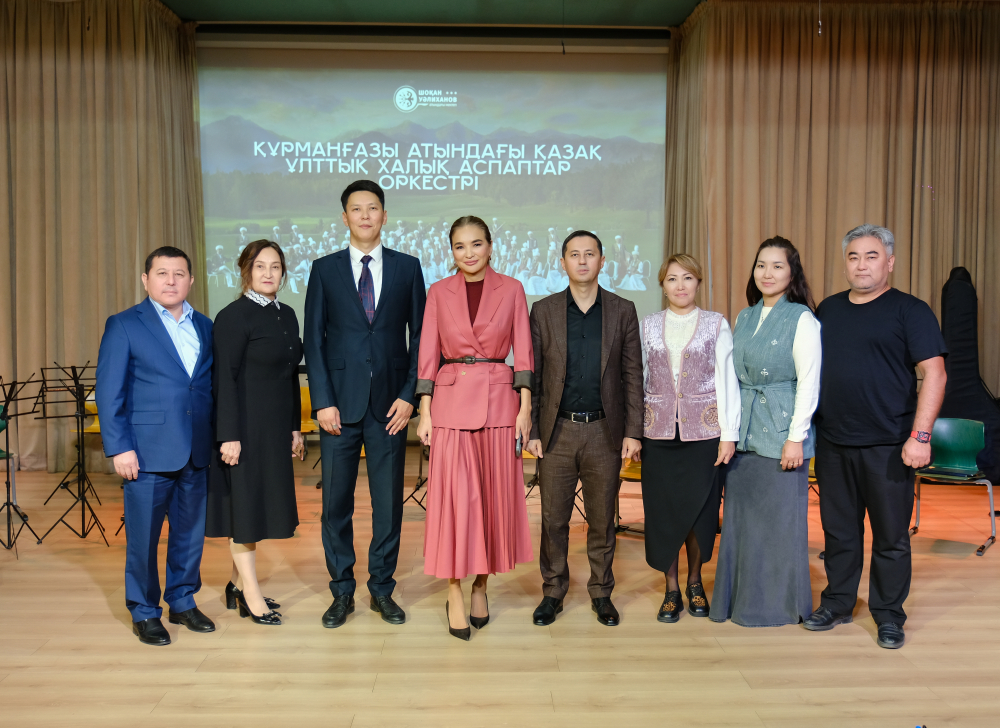
As part of this ongoing initiative, the Kurmangazy Kazakh State Academic Orchestra of Folk Instruments visited the school to lead an educational masterclass entitled “The Sounds of Traditional Instruments.”
Led by Chief Conductor Abylai Tilepbergen, a recipient of the Order of Kurmet, the orchestra introduced students to the history, construction and distinctive performance techniques of traditional Kazakh musical instruments. The musicians also shared the story behind the famous kui “Aksak Kulan,” illustrating how music can convey a narrative and bring historical events to life.
Students learned about the role of various instruments in the traditional orchestra, including the dombra, kylkobyz, sherter, prima kobyz, bass kobyz, bayan, flute and percussion instruments.
One of the highlights of the event was a joint performance of “Balbyraun,” a kui by Kurmangazy Sagyrbayuly, featuring the students alongside a small ensemble of orchestra musicians. The performance was more than a celebration of continuity between generations; it gave students the opportunity to experience the art they are learning alongside professional musicians.
Under the educational vision established by Asel Tasmagambetova, founder of Shokan Ualikhanov School, the promotion of national heritage goes hand in hand with modern education. This approach encourages students not only to learn about their cultural traditions but also to appreciate, preserve and carry them forward.
At Shokan Ualikhanov School, traditional Kazakh music is not simply a legacy of the past. It remains a living part of the nation’s cultural identity, shaping the values and perspectives of the younger generation. Traditions endure when children understand their significance, embrace them and pass them on to those who follow.